THE BLOODY CODE: CAPITAL PUNISHMENT IN LAW AND ART (Part 2)
Barbican Library, September 2026
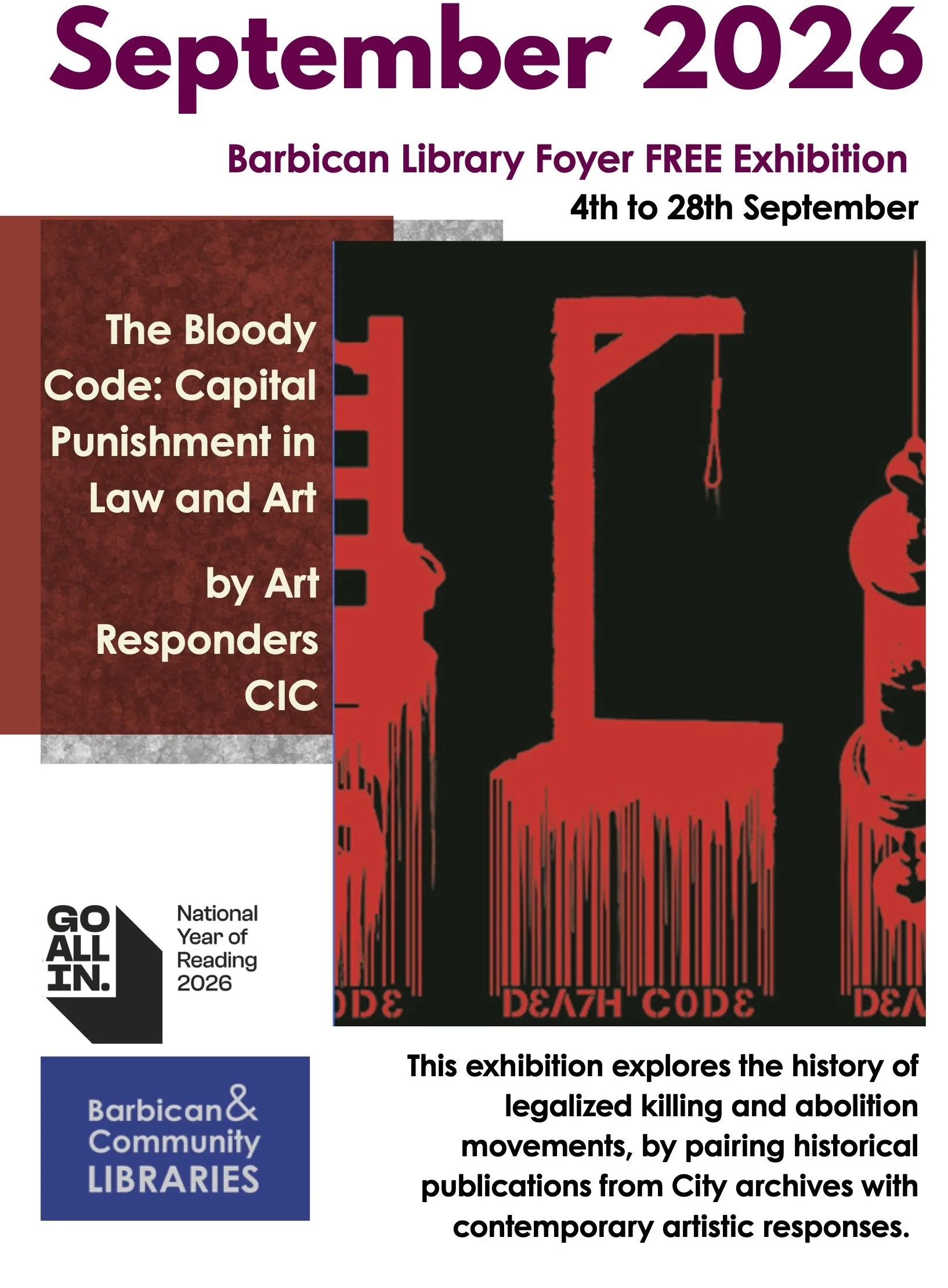
The Bloody Code visualises the history of capital punishment in the UK and internationally, exploring artists’ and writers’ changing responses to state-sanctioned execution over the centuries.
The exhibition brings two periods into dialogue: the Bloody Code era of public executions, from the late seventeenth to the mid-nineteenth century; and contemporary capital punishment in retentionist states, following the UK’s last executions in 1964.
Why revisit this history when the death penalty has been abolished in the UK? Capital punishment offers a lens through which to examine wider questions of state power, justice, inequality, human rights and social control. Abolition is not necessarily irreversible: in 1987, an unsuccessful attempt was made to restore capital punishment in Britain.
Internationally, the issue remains urgent. In 2025, recorded executions reached their highest level since 1981, driven by increases in a small number of states. Despite a continuing global trend towards abolition, capital punishment remains in use in countries including China, North Korea, Iran, the USA and Saudi Arabia. Japan, South Sudan, Taiwan and the United Arab Emirates also resumed executions in 2025.
By placing historical and contemporary practices alongside artists’ and writers’ responses, The Bloody Code asks what capital punishment reveals about the societies that authorise it—and about the relationship between justice, retribution, social control and the power of the state to take a life.
*If you have visited the exhibition, please see our contact page to complete an exhibition feedback form.
——————————————————————————————————————————————————————————————————————————————————
THE BLOODY CODE: CAPITAL PUNISHMENT IN LAW AND ART (Part 1)
Middle Temple Library, September 2025
2025 marks the 60th anniversary of The Murder (Abolition of Death Penalty) Act of 1965, which abolished capital punishment for murder in Great Britain and replaced the death penalty with a mandatory sentence of imprisonment for life. For this year’s London Open House Festival, Art Responders has curated an exhibition commemorating the history of capital punishment and the international drive for abolition.
Below is a list of resources for further exploration of this vital and internationally significant issue.

Below is a very preliminary list of recommended readings on the exhibition theme. To share your own recommendations, please email director@artresponders.com.
BOOKS:
· Ernest Gaines: A Lesson Before Dying (1992)*
· Truman Capote: In Cold Blood (1966)*
· Nicholas Yarris: The Fear of 13 (2016)*
· Maurice Chammah: Let the Lord Sort Them (2021)
· Jarvis Jay Masters: That Bird Has My Wings (2009)
· Arthur Koestler: Reflections on Hanging (1956) and Hanged by the Neck (1961)
· Sister Helen Prejean: The Death of Innocents (2005) and Dead Man Walking (1993)
*Titles available in the Barbican Library collection
ARTICLES:
(The Atlantic)
(The Atlantic)
(The Atlantic)
(The New Yorker)
(Washington Post)
· Geraldine Cremin: The Death Row Inmates Who Make Art (BBC)
(New York Times)
(The New Yorker)
More protest art against capital punishment:
Dead Wrong (Center for the Study of Political Graphics): Selected works from this exhibition are featured as part of “The Bloody Code”. The entire exhibition is available online at: https://www.politicalgraphics.org/dead-wrong
SONGS:
· Send Me to the 'Lectric Chair by Bessie Smith
· 'Lectric Chair Blues by Blind Lemon Jefferson
· Death Cell Blues by Blind Willie McTell
· Björk – 107 Steps
· Calexico – Victor Jara's Hands
· Heather Dale – Roddy McCorley
· "Hangman's Blues" by Blind Lemon Jefferson
· Fairport Convention – Poor Will and The Jolly Hangman
· Elvis Costello – Let Him Dangle
· Nick Cave and the Bad Seeds – The Mercy Seat
· "Electric Chair Blues" by Guitar Welch
· Queen – Bohemian Rhapsody
· David Bowie – Wide Eyed Boy from Freecloud
· Johnny Cash – 20 Minutes To Go
· "Death Row Blues" by Eric Bibb
· Bruce Springsteen – Dead Man Walking
· John Cooper Clarke – Suspended Sentence